
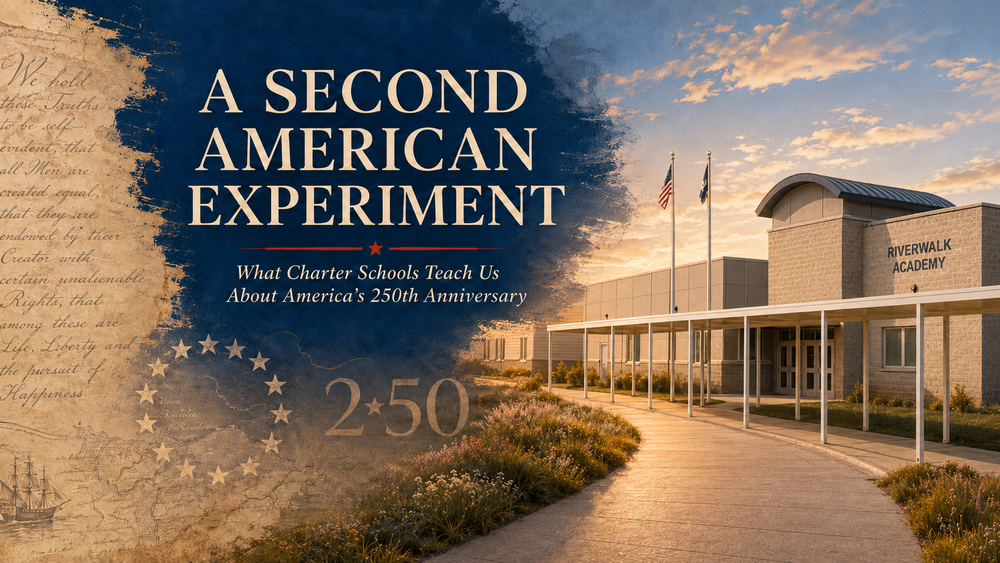
I'll admit it: I have been feeling patriotic lately. Between America's 250th anniversary and Netflix's The American Experiment, the founding of this country has been on my mind more than usual. One idea keeps surfacing: the American project was never guaranteed. It was, and still is, an experiment. That matters because I have spent my career inside another experiment, one that borrowed more from the Founders than most people realize.
Two hundred fifty years ago this month, colonists staked everything on that experiment. They had grievances, a draft of self-governance, and the conviction that people closest to a problem usually understand it better than distant authority does. The Declaration of Independence was not a finished system. It was a charter, a bet that free people, given room to govern themselves, would do it responsibly.
Charter schools were built on the same bet.
When Minnesota passed the nation's first charter school law in 1991, the idea was not the partisan symbol it became. It was a simple proposition: give educators and communities freedom to try new approaches, hold them accountable for results, and let the ones that work earn the right to continue.
Albert Shanker, the AFT's longtime president and an early influence on chartering, chose the word "charter" deliberately. It echoes the American premise: liberty granted on the condition that it be exercised responsibly, and renewed only if it earns its keep.
Anyone who has sat across from a school board, authorizer, or skeptical parent knows a charter is not a blank check. It is a contract that can be revoked, and every year, charter schools must prove the freedom they were given is being used well.
On a smaller scale, it is the same deal the Founders made about power: it flows from the people, and it can be withdrawn if abused. A charter school's freedom works the same way, granted by the public and forfeited if it fails.
The Declaration goes further: when a government stops serving the ends it was created for, Jefferson argued, people have the right to alter it and build something better.
That is the deeper argument for chartering. A parent watching a child struggle in a school that isn't working has standing to say so, and the right to build something that does.
Critics are right that charter results have been uneven. Some schools have transformed outcomes. Others have closed or stayed open too long.
But unevenness is not a flaw unique to charters; it is the price of experimentation. The Founders did not get every clause of the Constitution right either. They built in the ability to amend it. Charter schools were built with similar humility: not every idea will work, and the ones that do not should end.
Traditional systems make experiments too. A decade ago, districts spent billions putting devices in front of students, convinced access alone would transform learning. Many are now walking that back, restricting phones and laptops after watching outcomes suffer. The difference is that no one called it an experiment, and no authorizer could shut it down when it failed.
At their best, charters protect something American: the belief that good outcomes do not have to come from one government-approved method applied uniformly. Parents and educators closest to a child are allowed to decide what that child needs.
A suburban K-12 school built around project-based learning. A STEM academy. A school designed for students the traditional system had given up on. None had to win approval from a central bureaucracy before opening. They earned the chance to try, and they keep it only by showing it works.
That is not a rejection of public education. It is public education's oldest instinct, applied honestly. The same nation that refused to let one monarch decide how citizens should be governed has, through chartering, refused to let one system decide how every child should be taught.
As America marks its 250th anniversary, we celebrate a bet: that ordinary people, given freedom and accountability, could govern themselves better than any king.
Charter schools make a smaller version of that same bet every year. They ask a community to design something new, prove it works for children, and live with the consequences if it doesn't.
That is not a business model. That is not a political talking point. That is the American experiment, still running, in classrooms instead of colonies.
--
The above article was published in the Post & Courier on July 21, 2026.